← All Chapters
Summary Note 1 / 7

Chapter 1 – Occurrence of Groundwater (Theory)

GWE Handwritten Notes

Page 1

Page 1
Transcription

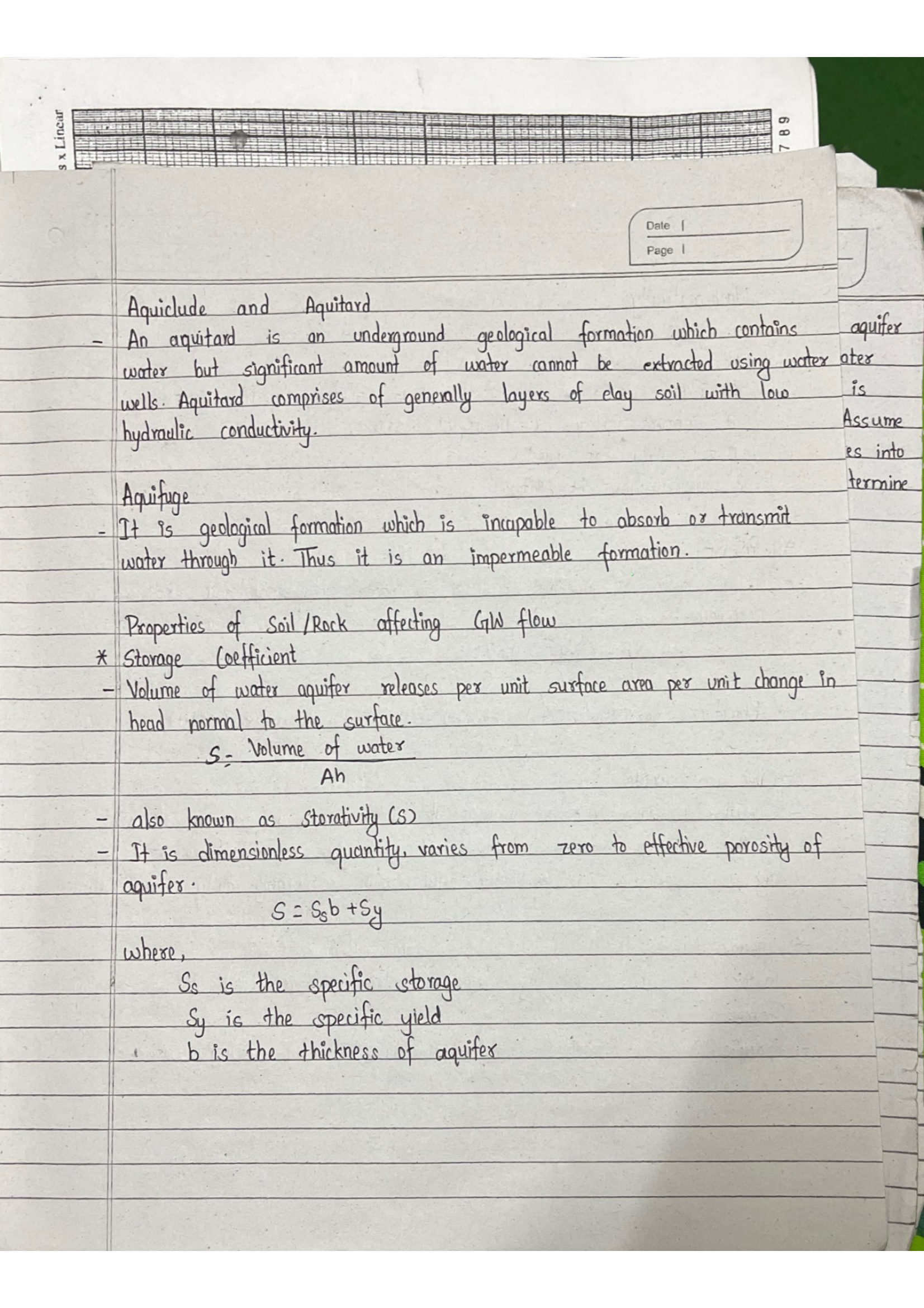
Groundwater Engineering

Date: 2081/08/03
Page |

Chapter-1

Occurrence of Groundwater

Water availability

→ 4.04% (Fresh water)

Hydrological Cycle and Groundwater

  • Hydrology is the study of movements and characteristics of groundwater.
  • The hydrologic cycle has a profound effect upon climate prediction.
  • Water is vital, So we must understand where to find water and how water supplies cycle through the Earth.
– Precipitation– Evaporation
– Infiltration– Transpiration
– Runoff– Groundwater flow
Cloud Precipitation Ocean/Lake Evaporation Transpiration Surface Runoff Infiltration Groundwater Flow →
Fig: The Hydrological Cycle — showing precipitation, infiltration, runoff, evaporation, and groundwater flow

Groundwater

  • Water found underground in the cracks and spaces in soil, sand and rock.

Major zones of Groundwater

  • → Zone of Aeration: Layer above water containing layer, unsaturated
  • → Zone of Saturation: Water containing layer

Water table is characterized by ground surface profile and similar to surface profile.
Ground Surface Zone of Aeration (Unsaturated / Vadose Zone) Pore spaces contain both air and water Soil moisture zone Capillary Fringe Water Table ▼ Zone of Saturation All pore spaces filled with water Impermeable Bedrock Well
Fig: Major zones of subsurface water distribution

Page 2

Page 2
Transcription

Date |
Page |

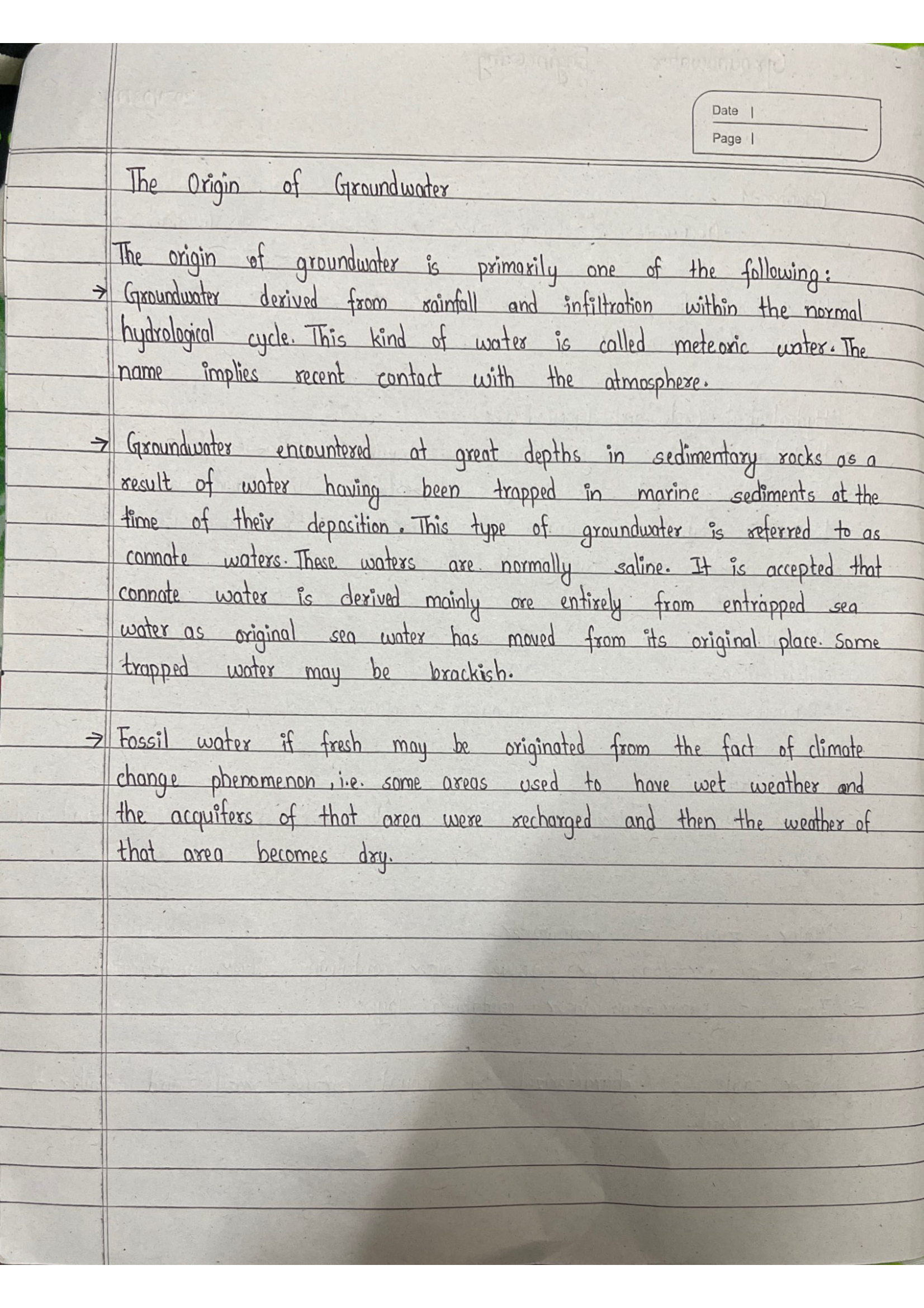
The Origin of Groundwater

The origin of groundwater is primarily one of the following:

  • → Groundwater derived from rainfall and infiltration within the normal hydrological cycle. This kind of water is called meteoric water. The name implies recent contact with the atmosphere.
  • → Groundwater encountered at great depths in sedimentary rocks as a result of water having been trapped in marine sediments at the time of their deposition. This type of groundwater is referred to as connate waters. These waters are normally saline. It is accepted that connate water is derived mainly or entirely from entrapped sea water as original sea water has moved from its original place. Some trapped water may be brackish.
  • → Fossil water if fresh may be originated from the fact of climate change phenomenon, i.e. some areas used to have wet weather and the acquifers of that area were recharged and then the weather of that area becomes dry.

Page 3

Page 3
Transcription

Date |
Page |

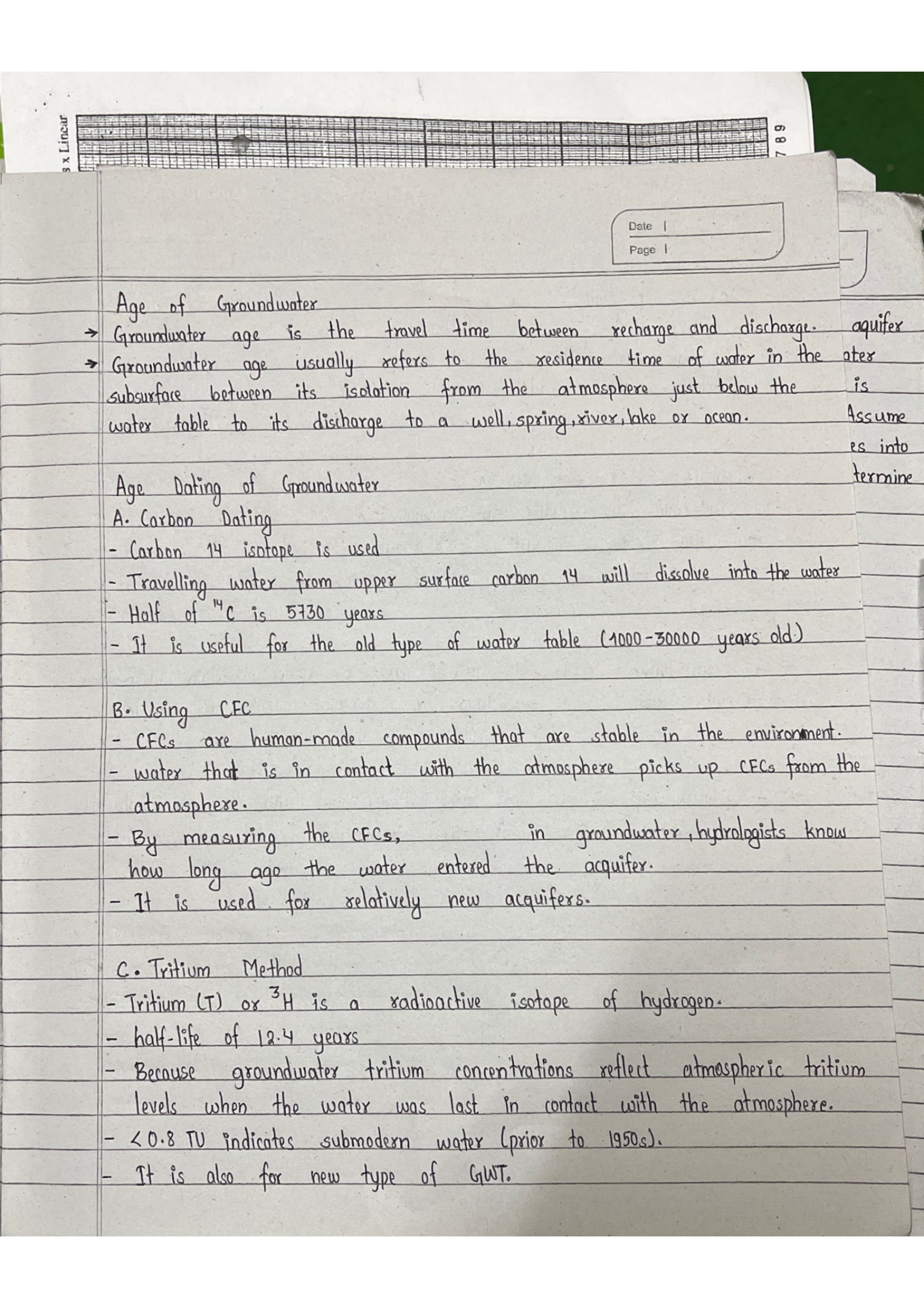
Age of Groundwater

  • → Groundwater age is the travel time between recharge and discharge.
  • → Groundwater age usually refers to the residence time of water in the subsurface between its isolation from the atmosphere just below the water table to its discharge to a well, spring, river, lake or ocean.

Age Dating of Groundwater

A. Carbon Dating
  • Carbon 14 isotope is used
  • Travelling water from upper surface carbon 14 will dissolve into the water
  • Half of ¹&sup4;C is 5730 years
  • It is useful for the old type of water table (1000–30000 years old)
B. Using CFC
  • CFCs are human-made compounds that are stable in the environment.
  • Water that is in contact with the atmosphere picks up CFCs from the atmosphere.
  • By measuring the CFCs, in groundwater, hydrologists know how long ago the water entered the aquifer.
  • It is used for relatively new aquifers.
C. Tritium Method
  • Tritium (T) or ³H is a radioactive isotope of hydrogen.
  • half-life of 12.4 years
  • Because groundwater tritium concentrations reflect atmospheric tritium levels when the water was last in contact with the atmosphere.
  • <0.8 TU indicates submodern water (prior to 1950s).
  • It is also for new type of GWT.

Page 4

Page 4
Transcription

Date |
Page |

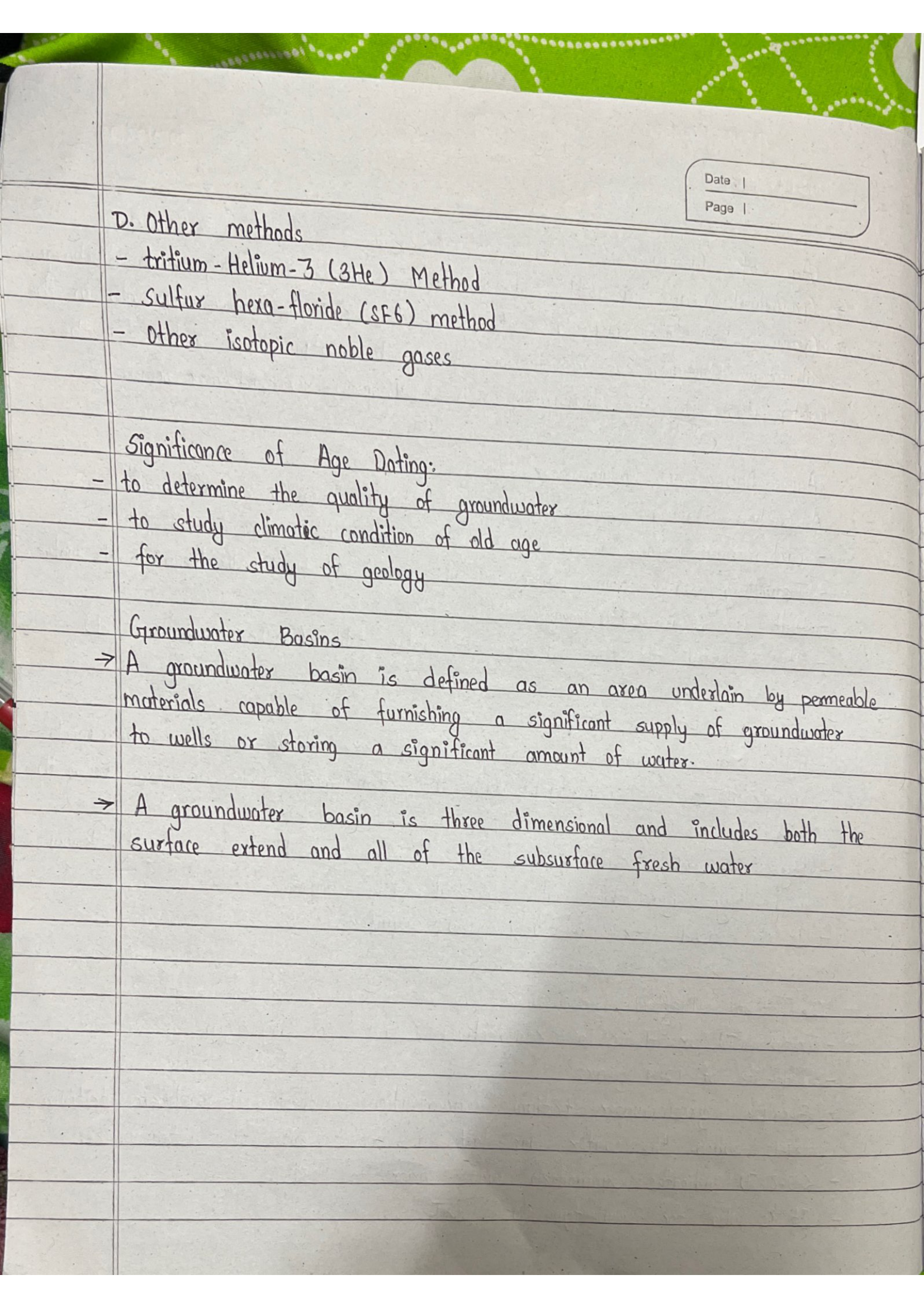
D. Other Methods
  • tritium–Helium-3 (³He) Method
  • sulfur hexa-floride (SF₆) method
  • Other isotopic noble gases

Significance of Age Dating:

  • to determine the quality of groundwater
  • to study climatic condition of old age
  • for the study of geology

Groundwater Basins

  • → A groundwater basin is defined as an area underlain by permeable materials capable of furnishing a significant supply of groundwater to wells or storing a significant amount of water.
  • → A groundwater basin is three dimensional and includes both the surface extend and all of the subsurface fresh water.

Page 5

Page 5
Transcription

Date |
Page |

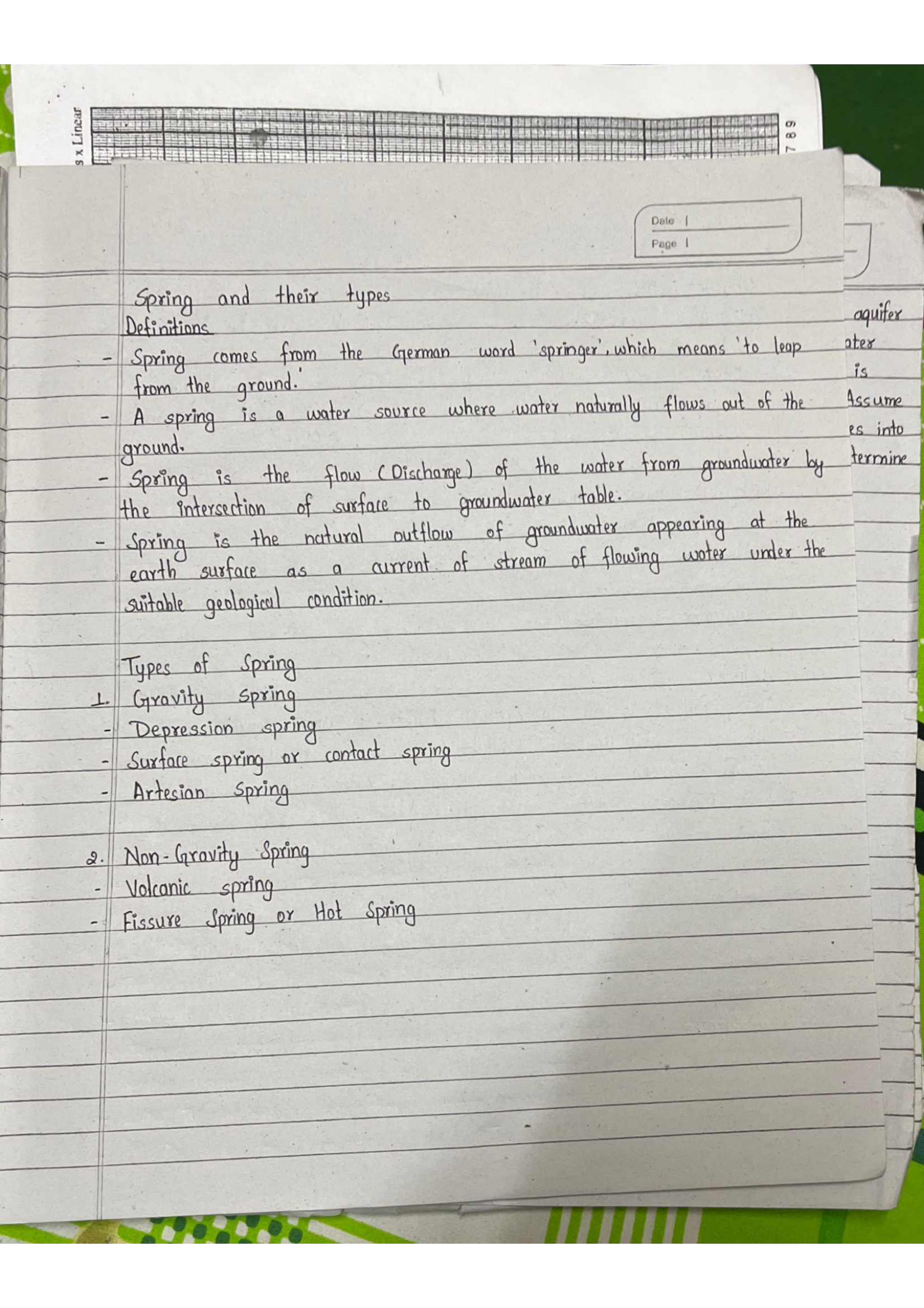
Spring and their Types

Definitions

  • Spring comes from the German word 'springer', which means 'to leap from the ground.'
  • A spring is a water source where water naturally flows out of the ground.
  • Spring is the flow (Discharge) of the water from groundwater by the intersection of surface to groundwater table.
  • Spring is the natural outflow of groundwater appearing at the earth surface as a current of stream of flowing water under the suitable geological condition.

Types of Spring

  1. Gravity Spring
    • Depression spring
    • Surface spring or contact spring
    • Artesian Spring
  2. Non-Gravity Spring
    • Volcanic spring
    • Fissure Spring or Hot Spring

Page 6

Page 6
Transcription

Date: 2081/08/06
Page |

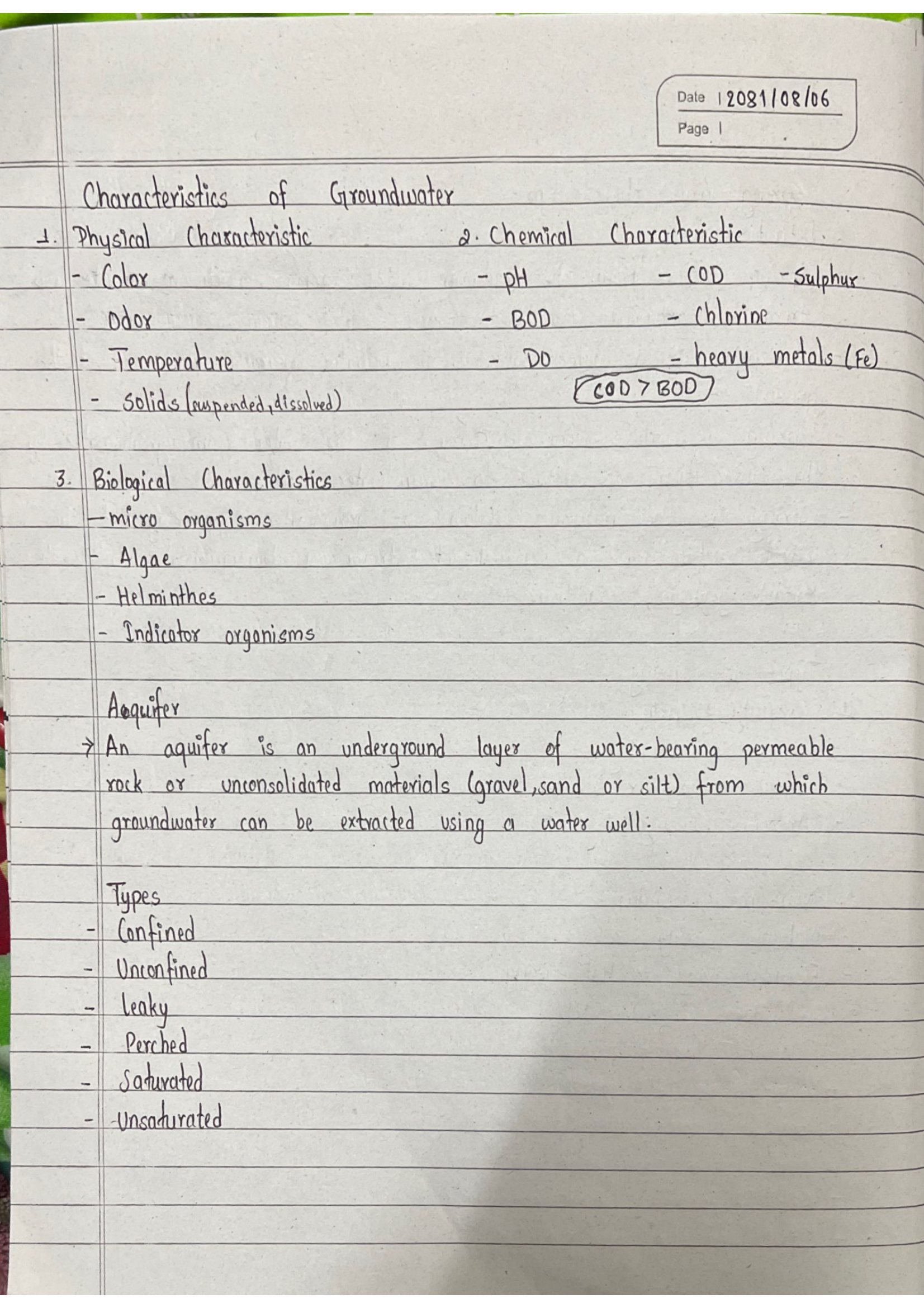
Characteristics of Groundwater

# Category Characteristics
1 Physical Characteristic
  • Color
  • Odor
  • Temperature
  • Solids (suspended, dissolved)
2 Chemical Characteristic
  • pH
  • BOD
  • DO
  • COD > BOD
  • Sulphur
  • Chlorine
  • heavy metals (Fe)
3 Biological Characteristics
  • micro organisms
  • Algae
  • Helminthes
  • Indicator organisms

Aquifer

An aquifer is an underground layer of water-bearing permeable rock or unconsolidated materials (gravel, sand or silt) from which groundwater can be extracted using a water well.

Types

  • Confined
  • Unconfined
  • Leaky
  • Perched
  • Saturated
  • Unsaturated
Ground Surface Unconfined Aquifer Water table = upper boundary Water Table (free surface) Confining Layer (Aquitard) Confined Aquifer Bounded above and below by impermeable layers Confining Layer (Aquiclude) Perched Aquifer Local impermeable lens Artesian well Piezometric Surface Bedrock (Aquifuge)
Fig: Types of aquifers — Unconfined, Confined, Perched, and Artesian well

Page 7

Page 7
Transcription

Date:   Page |

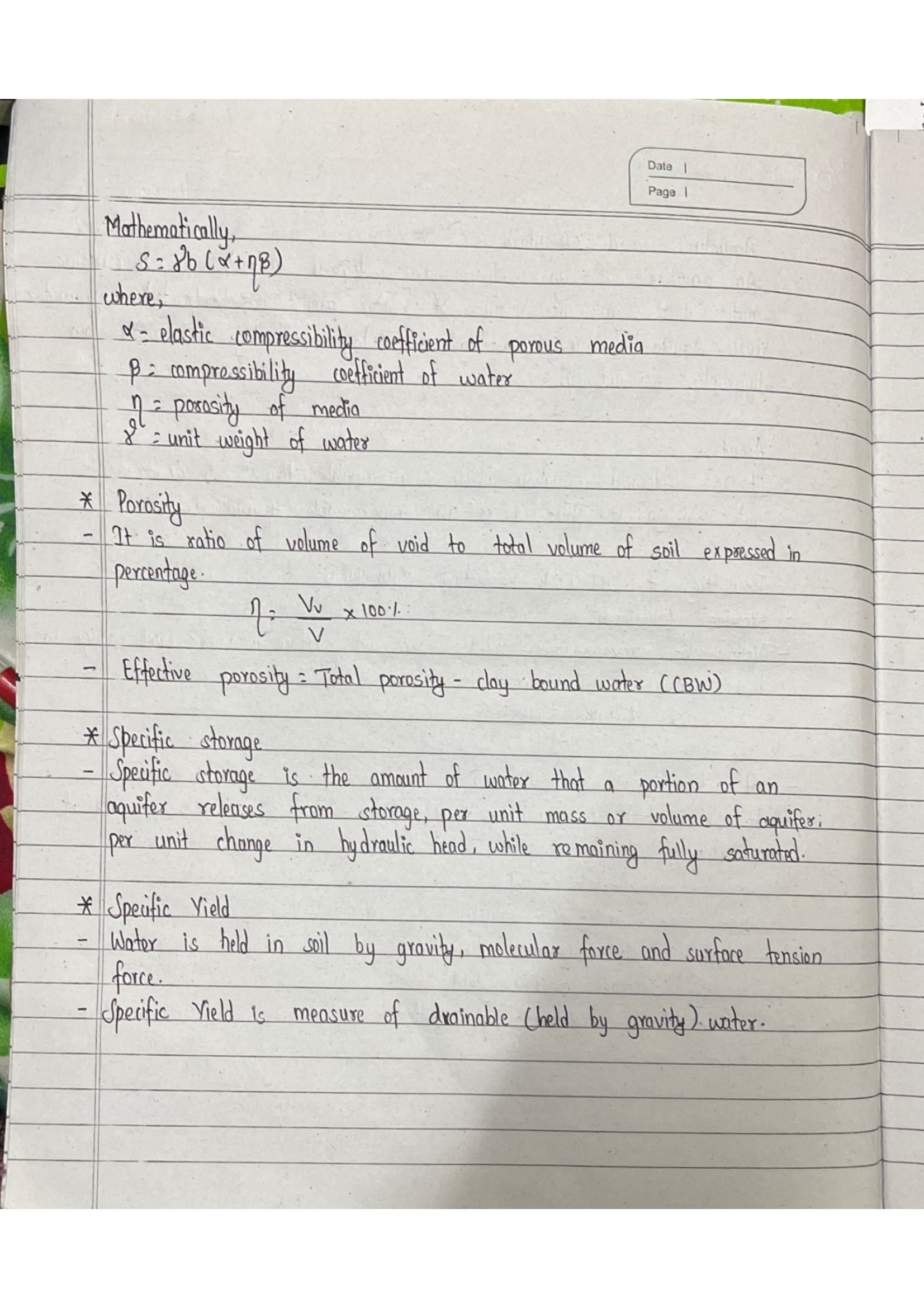
Aquiclude and Aquitard

An aquitard is an underground geological formation which contains water but significant amount of water cannot be extracted using water wells (filter).

Aquitard generally comprises layers of clay soil with low hydraulic conductivity.

Aquifuge

A geological formation which is incapable to absorb or transmit water through it. Thus it is an impermeable formation.

Properties of Soil / Rock affecting GW flow

Storage Coefficient

Volume of water an aquifer releases per unit surface area per unit change in head normal to the surface.

\[ S = \frac{\text{Volume of water}}{A \cdot \Delta h} \]

Also known as Storativity (S).

It is a dimensionless quantity, varies from zero to effective porosity of aquifer.

\[ S = S_s \cdot b + S_y \]

where:

  • \(S_s\) is the specific storage
  • \(S_y\) is the specific yield
  • \(b\) is the thickness of aquifer

Page 8

Page 8
Transcription

Date:   Page |

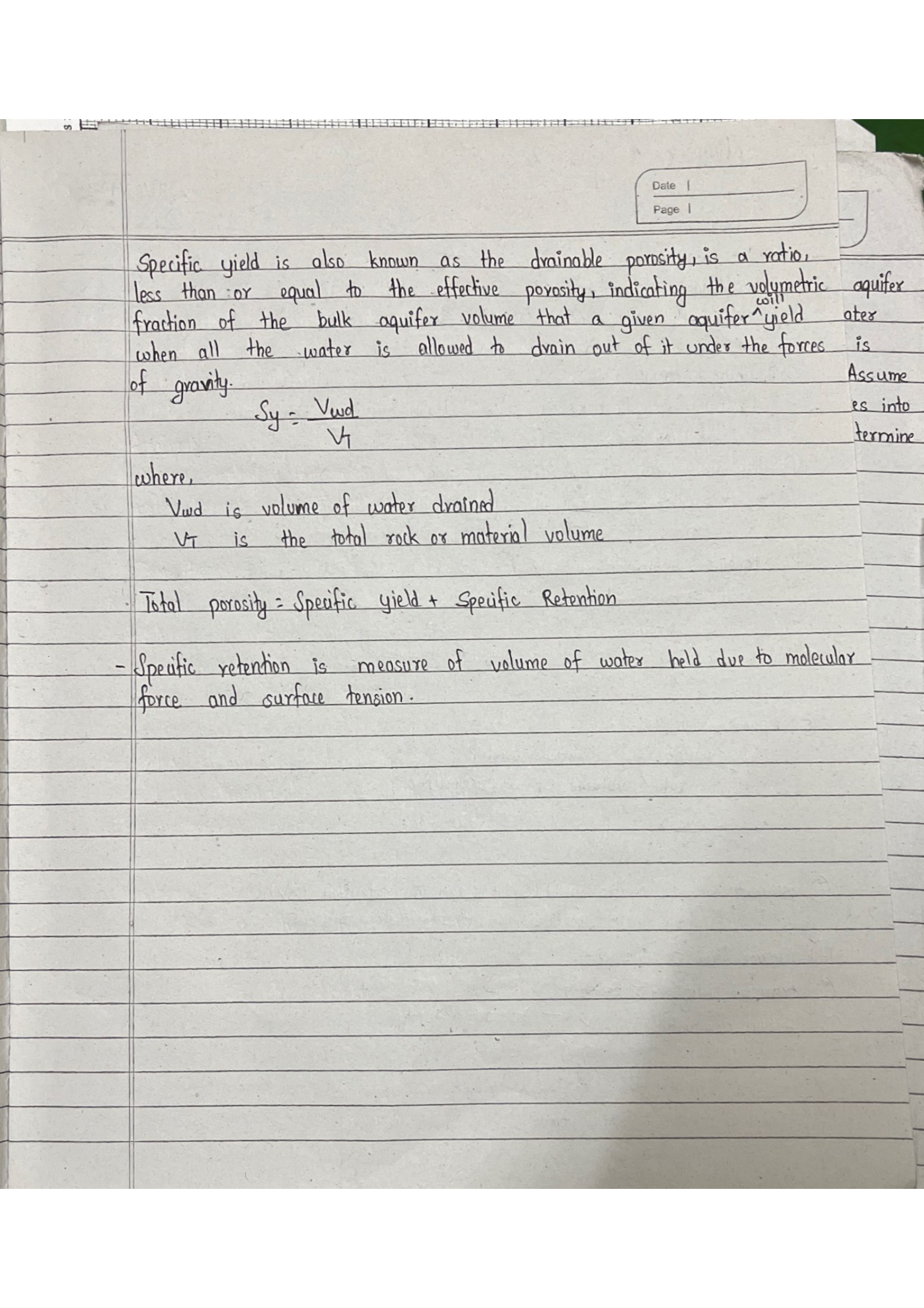
Mathematically,

\[ S = \gamma \, b \left( \alpha + \eta \, \beta \right) \]

where,

  • \(\alpha\) = elastic compressibility coefficient of porous media
  • \(\beta\) = compressibility coefficient of water
  • \(\eta\) = porosity of media
  • \(\gamma\) = unit weight of water

Porosity

It is the ratio of Volume of Void to Total volume of Soil, expressed in percentage.

\[ \eta = \frac{V_v}{V} \times 100\% \]

Effective porosity = Total porosity − clay bound water (CBW)

Specific Storage

Specific storage is the amount of water that an aquifer releases from storage, per unit volume of aquifer, per unit change in hydraulic head, while remaining fully saturated.

Specific Yield

Water is held in Soil by gravity, molecular force and Surface tension force.

Specific Yield is a measure of drainable (held by gravity) water.

Page 9

Page 9
Transcription

Date:   Page |

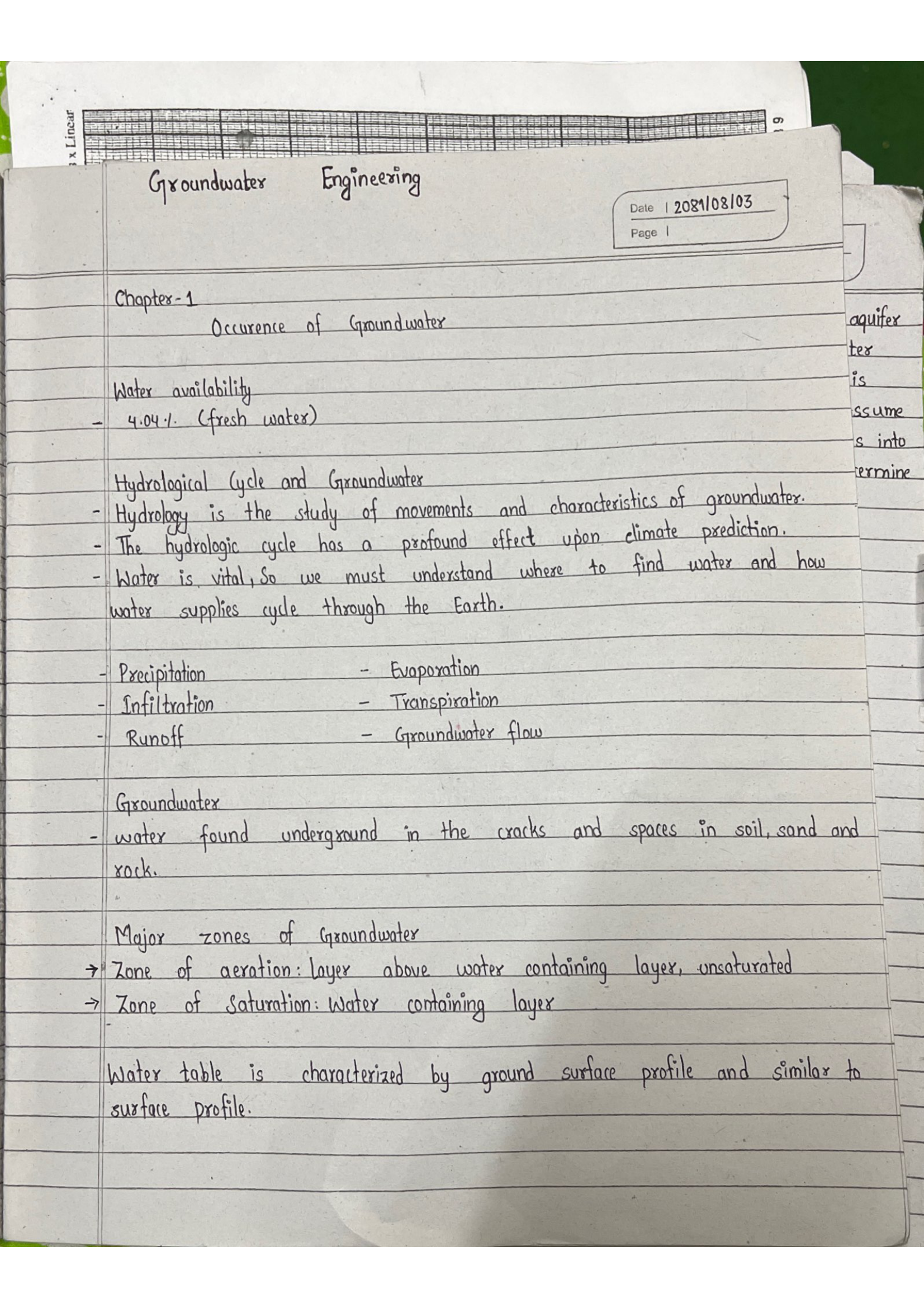
Specific yield is also known as the drainable porosity ratio. It is less than or equal to the effective porosity of the aquifer, indicating the volumetric fraction of bulk aquifer volume that will yield water when allowed to drain out of it under the forces of gravity.

\[ S_y = \frac{V_{wd}}{V} \]

where:

  • \(V_{wd}\) = volume of water drained
  • \(V\) = total rock or material volume
Total porosity = Specific yield + Specific Retention
Total Porosity (η) Specific Yield (S_y) Specific Retention (S_r) Water drained by gravity Water held by capillary & molecular forces η = S_y + S_r Typical values: Sand S_y ≈ 0.25, Clay S_y ≈ 0.03
Fig: Relationship between Total Porosity, Specific Yield, and Specific Retention

Specific retention is a measure of the volume of water held due to molecular force and surface tension force.